Every bookstore has an opinion about the difference between science fiction and fantasy, and ours is this: fantasy asks "what if magic were real," and sci-fi asks "what if we actually built the thing we're scared of." Spaceships, AI, cloning, first contact — it's speculative fiction with its sleeves rolled up, more interested in consequences than incantations. If our fantasy list was about escape, this one's about warning shots.
We've split this the way we'd actually hand-sell it in the shop: where to start if the genre intimidates you, where to go for scale and spectacle, where to go if you want your brain quietly rearranged, and where to go for the stuff that reads less like adventure and more like prophecy. All four sections stand alone, so skip around freely.
Where to start
These are the five books we'd put in the hands of someone who's "never really gotten into sci-fi." They're also, not coincidentally, five of the best books the genre has ever produced — accessible on the first read, and rewarding enough to survive a second one.
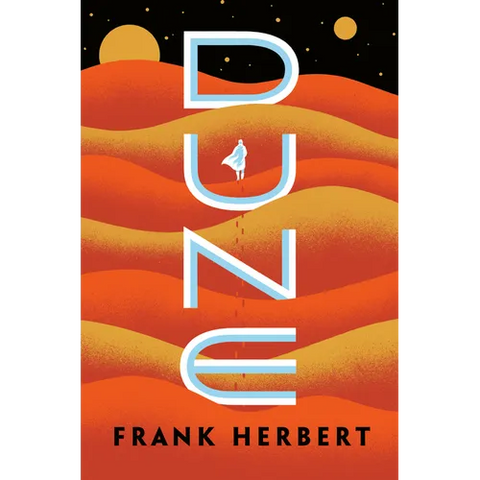
A desert planet, a substance worth more than anything else in the universe, and a young man being maneuvered into becoming a messiah whether he wants the job or not. Herbert built an entire ecology of politics, religion, and sand, and fifty-plus years later nobody's topped it. Read the first book before you touch the sequels — it's a complete story on its own, whatever the marketing tells you.
Earth is demolished on page one to make way for an interstellar bypass, and things get sillier from there. This is the funniest book in the genre by a wide margin, and also, quietly, one of the smartest — Adams uses absurdity to sneak in real ideas about meaning, bureaucracy, and the number 42. The perfect gateway drug for reluctant readers.
A mathematician predicts the fall of a galactic empire and engineers a plan to shorten the coming dark age from thirty thousand years to one. Foundation basically invented the "big idea" school of sci-fi that everything from Star Wars to modern space opera still borrows from. The prose is plain by design — Asimov wanted you thinking about civilizations, not sentences.
A child genius is trained through increasingly brutal war games to save humanity from an alien threat, and the ending recontextualizes everything that came before it in a way that's genuinely hard to see coming. One of the most-read sci-fi novels for a reason — it moves fast and it sticks with you.
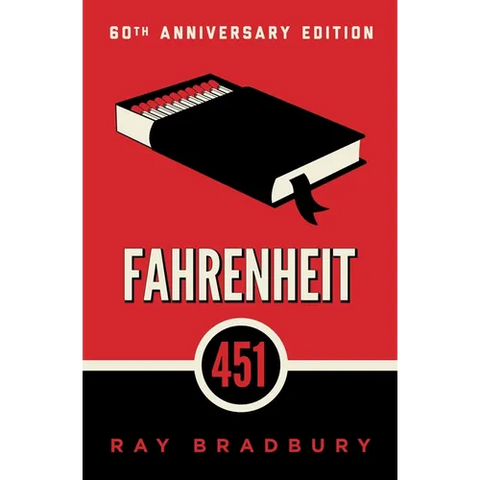
A fireman whose job is burning books starts wondering why, in a future where nobody reads and nobody wants to. It's short, it's furious, and it's aged in ways Bradbury probably didn't want to be right about. A book we're contractually obligated to love, running a bookstore, but it earns the position honestly.
Space opera and big ideas
This is sci-fi at full scale — galaxies, alien civilizations, and timelines measured in centuries. These are the books for when you want to feel small in the good way.
Seven pilgrims travel to a planet to meet a creature that may be a monster or a god, and each tells their own story along the way — a structure lifted straight from The Canterbury Tales and somehow made to feel completely fresh. Dense, ambitious, and unlike almost anything else on this list in shape and tone.
Humanity makes first contact with an alien civilization, and it does not go the way first-contact stories usually go. This is hard sci-fi with real physics underneath it, translated from Chinese and the first Asian novel to win the Hugo Award for Best Novel. Book one of a trilogy that gets stranger and bigger with every installment.
By
Adrian Tchaikovsky
A terraforming experiment goes sideways and, instead of uplifting monkeys, accidentally uplifts spiders into a technological civilization. It sounds like a joke premise and turns into one of the most genuinely moving books about intelligence, evolution, and what "alien" actually means that the genre has produced in years.
A lone astronaut wakes up with amnesia on a solo mission to save humanity from an extinction-level threat, and has to MacGyver his way through problems with nothing but chemistry, physics, and stubbornness. From the author of The Martian, and just as propulsive — this is the book for readers who want their sci-fi to feel like a thriller.
For when you want your brain rearranged
Less about spaceships, more about what happens to consciousness, language, and identity when the rules change. These are slower burns, and they're worth the patience.
By
Ursula K. Le Guin
An envoy is sent to a planet where the inhabitants have no fixed gender, shifting between male and female each month — and the book uses that single premise to quietly dismantle almost every assumption you didn't know you had about identity and politics. Cold, beautiful, and one of the most important novels the genre has ever produced.
The book that invented the word "cyberspace" and basically willed the aesthetic of cyberpunk into existence before the internet as we know it even existed. A washed-up hacker is pulled into one last job that's bigger than he understands, told in prose so dense and stylized it practically hums. The Matrix owes this book its entire personality.
By
Philip K. Dick
The novel Blade Runner was loosely based on, and stranger and more melancholy than the film — a bounty hunter tracks down escaped androids in a post-apocalyptic Earth while quietly losing his grip on what separates human empathy from a very good simulation of it. Dick's paranoia has never felt more prophetic.
By
Peter Watts
A first-contact story that asks whether consciousness is actually necessary for intelligence — and builds a genuinely unsettling case that it might not be. Hard sci-fi at its hardest, free to read legally online from the author himself, and one of the most quietly disturbing books you'll find in this section.
Dystopia and social sci-fi
The genre at its most political — futures built as warnings, not blueprints. Some of these are a century old and somehow feel more current every year.
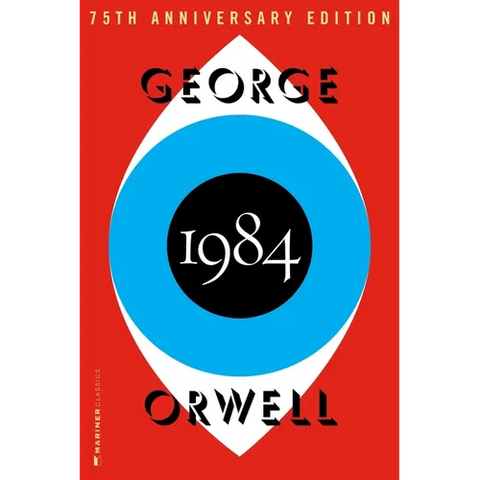
Surveillance, propaganda, and the deliberate corruption of language, in the book that gave us Big Brother and "doublethink" as everyday vocabulary. Still the reference point every other dystopia gets measured against, for good reason.
The other great twentieth-century dystopia, and arguably the more prescient one — a future controlled not through fear and surveillance but through pleasure, comfort, and manufactured contentment. Read alongside 1984 and the two make an unsettling, essential pair.
A physicist travels between two neighboring worlds — one an anarchist utopia, one a capitalist state — and the book refuses to let either one off easy. Subtitled "An Ambiguous Utopia" for a reason: this is political sci-fi that argues with itself honestly instead of picking a side and preaching it.
By
Walter Miller
Centuries after a nuclear apocalypse, monks in the American desert preserve scraps of pre-war knowledge as sacred relics, understanding almost none of it. Spans a thousand years and asks, quietly and devastatingly, whether civilization is capable of learning from its own mistakes. One of the finest and most overlooked novels the genre has produced.
Where to go from here
If this list scratched the "big ideas" itch, our 50 best fantasy books of all time is the natural next stop for more speculative fiction, minus the science. And if you're the type who wants a plan for tackling a series properly rather than winging it, keep an eye out — reading-order guides for a few of the genre's biggest names are coming soon.
Missing a favorite? Let us know — this list is exactly the kind of thing we're happy to keep expanding.







![The Dispossessed [50th Anniversary Edition]](http://blackandbarhe.com/cdn/shop/files/J30XEQLkpX9780063414334.webp?v=1783048904&width=480)


