

We should get our bias out of the way first: we sell print books. So when we tell you print books are more sustainable, you should reasonably wonder whether we've checked or whether we're just selling.
We checked. And the honest answer is more complicated than either side of this argument usually admits — most of the "print is greener" content online cites a number that's simply wrong, and most of the "digital is greener" content quietly assumes you'll keep the same device for a decade. Here's what the actual research says.
What the research actually says
Every serious study frames this the same way: an e-reader costs a lot of carbon to manufacture and almost nothing to use. A print book costs a moderate amount to manufacture and nothing at all to use. So the question is how many print books you'd have to replace before the e-reader's manufacturing debt is paid off.
The estimates vary more than you'd expect:
- The frequently cited Cleantech Group analysis put a Kindle's lifecycle footprint around 168 kg of CO2, with a break-even point of roughly 23 books.
- Carbon researcher Mike Berners-Lee estimates one e-reader is equivalent to about 36 paperbacks.
- A widely referenced 2011 lifecycle study landed at 30 to 40 books over the device's life.
- Broader analyses that count water use, mineral extraction, and human health impacts alongside carbon push the figure closer to 70 to 100 books.
The industry figure for a single print book sits around 4 kg of CO2, or roughly 8.85 pounds, from a 2008 study of the US book industry — which also estimated the industry consumed about 30 million trees that year.
So: somewhere between twenty and a hundred books. That's a wide range, and the spread isn't sloppiness. It's because the studies are measuring different things (carbon only, versus water and minerals and toxicity) and assuming different behavior. Which brings us to the part that actually matters.
The number that decides it is how long you keep the device
Here's the thing almost nobody mentions: the average e-reader lifespan used in these studies is about three years.
Three years. That's the entire ballgame. If you read thirteen books a year and keep your e-reader for three years, you come out ahead. If you read thirteen books a year and replace your e-reader every two years because a new model came out with a slightly better screen, you never break even — you just keep restarting the debt.
This is why the format question is mostly the wrong question. A person who reads fifty books a year on a single device they keep for eight years is doing well. A person who reads six books a year on a tablet they replace constantly is not, and no amount of "but it's paperless" fixes that. The device isn't the problem. The upgrade cycle is.
Worth noting too: e-readers are genuinely difficult to recycle, and the valuable metals inside them are mostly lost at end of life. Books are among the least problematic things in a landfill — they're paper — and they're recyclable nearly everywhere.
Where e-books genuinely win
We'd rather be useful than partisan, so let's be clear about this: there are readers for whom e-books are straightforwardly the better choice, and it isn't close.
Accessibility. Adjustable text size, adjustable contrast, and text-to-speech make e-readers transformative for people with low vision, dyslexia, or conditions that make holding a physical book difficult. This is the single strongest argument for the format and it deserves to be stated plainly rather than buried in a list of features.
Volume readers. If you're reading fifty-plus books a year, the math genuinely favors digital, provided you keep the device.
Access. If you live somewhere without a decent bookstore or a well-funded library, an e-reader may be the difference between reading widely and not.
Space. A studio apartment has a finite number of shelves. This is a real constraint and not a character flaw.
Where print genuinely wins
Beyond the environmental case, a few advantages that hold up under scrutiny:
You actually own it. An e-book is a license, and licenses can be revoked. Publishers have pulled titles from purchased libraries before, and platform lock-in means your collection lives or dies with a company's business decisions. A book on your shelf has no terms of service.
It can be given away. You cannot lend, sell, donate, or leave an e-book to anyone. Every print book can be read by dozens of people over its life, which is both a social good and, incidentally, the strongest environmental argument there is.
No notifications. A book cannot interrupt you. On a general-purpose tablet, you are one accidental swipe from your inbox.
Recall and spatial memory. Research on reading comprehension across formats is genuinely mixed and often overstated in print's favor — but the finding that holds up reasonably well is that physical books give readers better spatial memory for where in a text something appeared, which helps with dense or reference material.
The most sustainable book is the one that already exists
Here's the answer that doesn't appear in most versions of this argument, largely because it isn't good for anyone's sales figures — including, mostly, ours.
A used book has already paid its carbon debt. It was manufactured years ago. Buying it produces no new printing, no new pulp, no new device. Its remaining footprint is a padded envelope and a delivery van, and it keeps a functioning object out of a landfill. A used book beats both a new hardcover and a new e-reader, and it isn't close.
So the honest hierarchy, if you're optimizing for this: borrow it from a library, buy it used, buy it new in print, or read it on a device you intend to keep for the better part of a decade. Any of those beats a new device replaced every two years. And all of them beat not reading, which is the outcome the internet is actually competing for.
We run a used book return program for exactly this reason — books come back to us, get checked over, and go out again. It's the least glamorous part of the shop and probably the part we're proudest of.
Further reading on reading
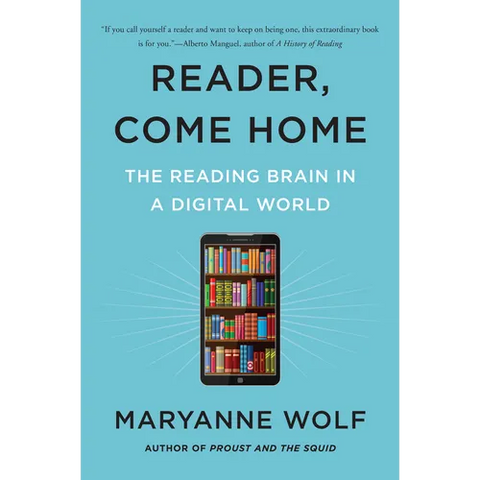
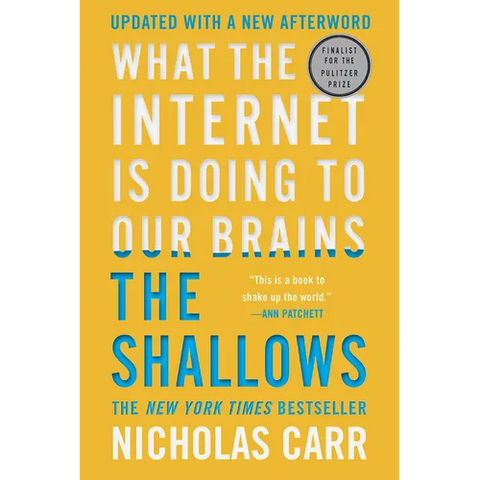
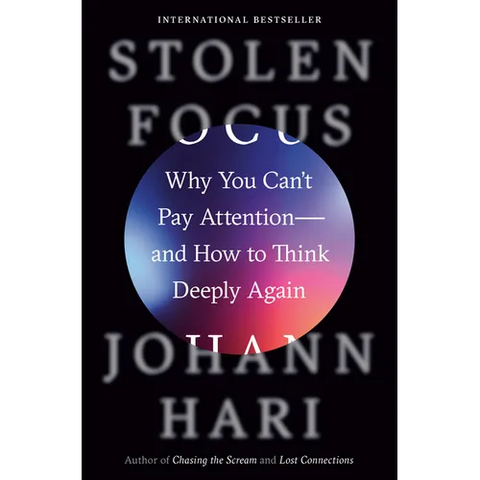
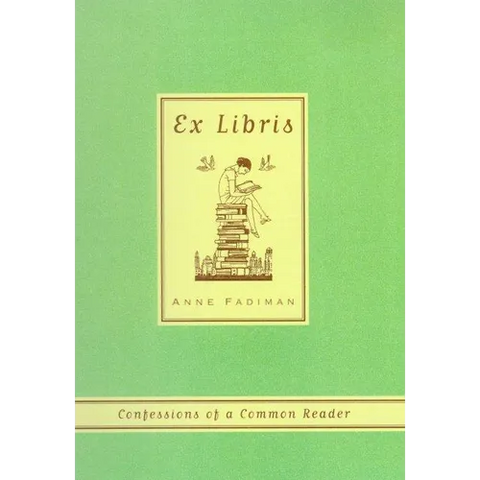
If the question of what different formats do to attention and comprehension interests you, a few books that take it seriously:
Where to go from here
If the attention question is the part that hooked you, our case for abandoning books guilt-free covers a related problem, and our notes on getting the most out of reading cover what to do once you've found something worth finishing.


