

The Pirates Had Workers' Comp
If you lost your right arm in a fight aboard a pirate ship in the 1720s, the articles you had signed before the voyage entitled you to six hundred pieces of eight. A left arm was worth five hundred — the difference being that most men are right-handed, and the compensation was calibrated to how much work you'd lost the ability to do. A leg or an eye had its own rate.
This was written down. Every crew member had sworn to it before the ship sailed. In the same decade, a sailor in the Royal Navy who lost an arm in service to the Crown could expect a small pension if he was lucky and the paperwork went his way, having been very possibly dragged aboard against his will by a press gang in the first place.
The pirate ship is remembered as a floating dictatorship — one tyrant in a big hat, ruling by terror. That picture comes almost entirely from fiction, and it has the situation more or less exactly backwards. The tyranny was on the naval and merchant vessels. What the pirates built, out of necessity rather than idealism, was one of the most genuinely democratic institutions in the Atlantic world of its time.
How a pirate ship was actually governed
Before a voyage, a crew drew up Articles of Agreement — a written constitution covering conduct, discipline, the division of plunder, and compensation for injury. Every man had to consent and swear to them. If a faction disagreed strongly enough, they could draw up their own articles, elect their own officers, and sail off separately.
Power was split three ways, which is the part that tends to stop people:
The captain was elected, and could be voted out at any time. His authority was absolute only during battle or a chase — the two situations where argument gets people killed. The rest of the time he was one voice among many. Crews deposed captains for cowardice, for incompetence, and, notably, for treating prisoners either too cruelly or too kindly. He ate the same food as everyone else.
The quartermaster was separately elected, and existed specifically to check the captain. He distributed food and plunder, arbitrated disputes between crew members, and determined punishments. One contemporary account put it plainly: the captain could undertake nothing the quartermaster didn't approve. Historians have compared the role to a judiciary and a chief financial officer combined.
The common council was sovereign. Marcus Rediker, the historian who has done more work on this than anyone, calls it a floating town meeting. Anyone who had sworn to the articles could vote. It decided where to sail, whom to attack, how to handle disputes the quartermaster couldn't settle, and who held office.
An elected executive with limited powers, a separately elected officer to check him, and a legislative assembly with final authority. Historians comparing pirate articles to the founding documents of the United States have noted the resemblance, and the chronology is worth sitting with: pirates were operating this way by the 1670s. England's own constitutional settlement came with the Glorious Revolution in 1688. The US Constitution was written in 1787.
The money
Plunder was divided on fixed shares written into the articles. A regular crew member got one share. Skilled positions — carpenter, gunner, sailing master — got about one and a quarter. The captain and quartermaster got one and a half to two.
Two shares. That was the top of the pay scale.
Compare that to a merchant vessel of the same period, where the captain might earn many times what a common sailor did, or a naval ship with its elaborate ladder of ranks and pay grades. Rediker describes the pirate system as possibly the most egalitarian plan for distributing resources to be found anywhere in the early eighteenth century — and he means it literally, not as a flourish. He and Peter Linebaugh describe the pirate ship as democratic in an undemocratic age and egalitarian in a hierarchical one.
The injury compensation is the detail that surprises people most, because it's recognizably workers' compensation — a written schedule of payments for specific injuries, funded from the common pot, agreed in advance by everyone it covered. It appears in pirate articles roughly two centuries before industrial nations got around to legislating anything similar.
Why they built it
Here's the part that makes this more than a fun fact, and it's not that pirates were secret idealists.
Most pirates were former naval or merchant sailors. They knew exactly what unchecked authority at sea looked like, because they had lived under it: impressment, flogging, arbitrary punishment, wages withheld or never paid, officers with total power over working men who had no recourse whatsoever. Rediker's term for pirates is masterless men — people who had violently rejected that arrangement and were not about to rebuild it.
And there was a hard practical constraint underneath the principle. A pirate crew was, by definition, a group of armed men who had already demonstrated a willingness to mutiny, and who would all hang if caught. You cannot rule such a group by fear. There's no admiralty to appeal to, no marines to enforce your orders, nowhere to send a troublemaker. The only stable way to run a ship like that is consent — real consent, structured, written down, revocable.
Pirate democracy wasn't a philosophy. It was engineering, done by people with an unusually direct stake in getting it right.
Where the romance falls apart
All of which is true, and none of which makes pirates heroes. We'd rather give you the whole record than the flattering half of it.
Pirates were violent criminals who robbed working sailors, tortured captives for information about hidden valuables, and killed people. The democracy was strictly internal — a constitution for the people inside the ship, and nothing at all for anyone on the receiving end of it. Every protection described above stopped at the rail.
The racial picture is genuinely mixed, and it's where the popular version most needs correcting. Rediker's survey of fifteen pirate ships found that close to a third of the crews were recorded as Black, and there are real cases of formerly enslaved men serving as full voting members with equal shares. That was extraordinary for the period, and it happened.
But historians including Arne Bialuschewski have documented the other side thoroughly: pirates frequently captured slave ships for the vessels themselves — fast, built to carry large crews — rather than out of any interest in the people aboard. Captured Black men were often forced into menial labor rather than enrolled as equals. Stede Bonnet sold captives. After Bartholomew Roberts was killed and his crew taken, around twenty-one Black crew members were sold back into slavery. Some pirate ships were sites of remarkable equality. Others simply participated in the trade.
Both of these are the historical record. A shop with a pirate on the sign doesn't get to quote only the first half.
What it's actually worth knowing
The reason this history matters isn't that pirates were good. It's that the most democratic institution in the Atlantic world in 1720 was built by people the state had declared enemies of all mankind — while the legitimate powers of the era ran on impressment, flogging, and hereditary rule.
That's a genuinely useful thing to know about where good ideas come from. They don't reliably originate with the respectable. Quite often they get worked out at the margins, by people with nothing left to lose, and only later get adopted by institutions that would have hanged their inventors.
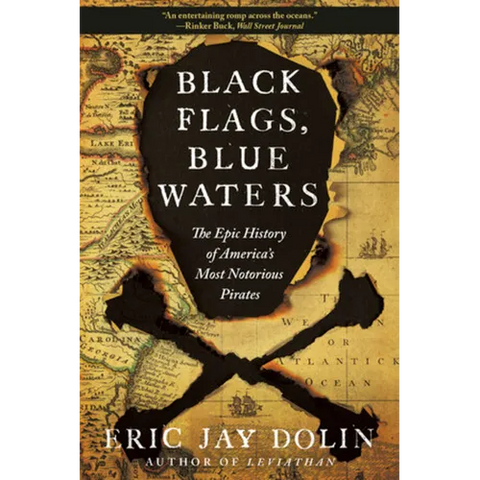
Books on the real history of piracy
If you want the actual scholarship rather than the movie version, start here.




More from the crow's nest
For the fiction side of all this, our list of the best pirate books covers the novels and the histories together, and the best sea adventure books goes wider across the whole nautical shelf. If the governance question is the part that grabbed you, our guide to 21 books that explain fascism covers the same subject from the opposite direction.


