

Stephen King Testified Against His Own Publisher
In the summer of 2022, Stephen King flew to Washington to testify in a federal antitrust trial. He testified against his own publisher.
Penguin Random House wanted to buy Simon & Schuster — King's publisher of forty years — for $2.175 billion. The Department of Justice sued to stop it. King took the government's side, and in November, Judge Florence Pan blocked the deal.
The trial produced something rare: thirteen days of sworn testimony about how the book business actually works, from the people who run it. Most of what's in this post comes from that record. It's worth knowing, because the structure it revealed determines which books get written, which get published, and which quietly never happen at all — and almost none of that is visible from the shelf.
Who actually publishes the books you read
American trade publishing runs through five companies, known unimaginatively as the Big Five: Penguin Random House, HarperCollins, Simon & Schuster, Hachette, and Macmillan. Together they control somewhere around 80 to 90 percent of the US trade market.
Look one level up and it gets more interesting, because most of them aren't book companies:
- Penguin Random House is owned outright by Bertelsmann, a German media conglomerate. It's the largest trade publisher in the world by a wide margin, with 2025 revenues around €5 billion.
- HarperCollins is owned by News Corp — Rupert Murdoch's company, which also owns the Wall Street Journal, the New York Post, and Fox's newspaper assets.
- Simon & Schuster, after the failed merger, was sold by Paramount to KKR — a private equity firm — for $1.62 billion.
- Hachette is owned by Lagardère, a French conglomerate.
- Macmillan is owned by Holtzbrinck, a German family-owned group.
The hundreds of imprint names you see on spines — Knopf, Viking, Riverhead, Doubleday, Crown, Ballantine — mostly sit inside those five companies. The variety on the shelf is largely a variety of brands, not a variety of owners.
And one fact from the trial worth sitting with: the DOJ attorney pointed out that no new publisher has broken into the Big Five in more than thirty years. This is not a market anyone is entering.
What the trial was actually about
Here's the part that makes this case unusual. Most antitrust cases are about consumers paying more. This one wasn't. The government argued the harm would land on authors.
The term for it is monopsony — the mirror image of monopoly. A monopoly is one seller and many buyers. A monopsony is one buyer and many sellers, and the power runs the other direction: when there are fewer bidders for your work, your work is worth less.
The government's evidence was specific. It identified books that Penguin Random House and Simon & Schuster had bid against each other for, and showed that the competition drove the author's advance up. Remove one bidder and that money simply doesn't get paid. The judge found that a combined company would have controlled 49 percent of the market for US publishing rights to anticipated top-selling books — more than double its nearest competitor — and that the resulting Big Four would hold around 91 percent.
Judge Pan blocked the merger. The Justice Department's antitrust chief said the deal would have "diminished the breadth, depth, and diversity of our stories and ideas."
That's the sentence to hold onto, because it names the actual mechanism, and it isn't about money.
The filter nobody sees
An advance is not a bonus. It's the money that makes a book physically possible — the rent an author pays during the two or five or eight years it takes to write the thing. Serious nonfiction, in particular, does not get written without one. Research costs money. Travel costs money. Time costs money.
So the acquisition decision — which manuscripts get bought, and for how much — is the real chokepoint in publishing. Not what gets banned. What gets funded.
When five companies make nearly all of those decisions, and each of them answers to a conglomerate or a private equity firm with quarterly expectations, the pressure runs in a predictable direction: toward the safe bet. Toward the proven author over the unknown one. Toward the book that resembles last year's bestseller. Toward the celebrity memoir with a guaranteed audience over the strange, difficult, possibly brilliant thing by someone nobody has heard of.
None of this requires anyone to be a villain. It's just what concentrated markets do. But the result is a category of book that never reaches a shelf to be objected to, because it was never bought — and unlike a banned book, nobody can point at it, because it doesn't exist.
Then there's Amazon
Publishing is concentrated. Bookselling is more concentrated still.
Amazon accounts for roughly half of all US print book sales. Its share of the US ebook market runs around 67 to 68 percent, and estimates reach into the 80s when Kindle Unlimited is included. About 80 percent of e-readers sold in the US are Kindles. Audible, which Amazon bought in 2008, holds roughly 63 percent of the US audiobook market.
Now stack the roles:
- Amazon is the dominant retailer. It sells the books.
- Amazon is a publisher. Amazon Publishing acquires and publishes its own titles, competing with the companies whose books it sells.
- Amazon owns the platform where readers decide what to read. It bought Goodreads in 2013.
- Amazon controls the largest self-publishing pipeline. Kindle Direct Publishing accounts for around 31 percent of ebook sales on the platform.
One company is the storefront, a competing supplier, the ratings system, and the printing press. In most industries that combination triggers regulatory alarm. In books it's simply the water everyone swims in — and it means a single company's algorithm changes, fee structures, and category rules exert more influence on what sells than any editor alive.
What's genuinely true on the other side
We'd be doing exactly what we criticize if we skipped this part.
Big publishers do real work. They pay advances no one else can. They employ editors who make books substantially better, publicists who get them noticed, and distribution networks that put them in every store in the country. A world of only small presses would be a world with far fewer books that took eight years to write. Our argument with the Big Five is about concentration, not competence.
Self-publishing is a real democratization. Thousands of authors who would have been rejected by every gatekeeper now reach readers directly and make a living at it. Romance in particular has been transformed by independent authors. Anyone arguing this is uncomplicated has not talked to those writers.
And access genuinely expanded. If you live somewhere without a bookstore — which describes a great deal of the country — online retail may be the only reason you can get a book at all, quickly and cheaply. That's not nothing, and we're not going to pretend otherwise.
What that access actually costs
But "they made books easier to get" is not the whole ledger, and the rest of it is a matter of public record rather than opinion.
In December 2024, the Senate Health, Education, Labor and Pensions Committee released the findings of an eighteen-month investigation into Amazon's warehouses. It reviewed seven years of the company's own injury data and interviewed more than 130 workers. What it found:
- Over seven years, Amazon warehouse workers were nearly twice as likely to be injured as workers at other warehouses in the same industry. In 2023 alone, Amazon facilities recorded over 30 percent more injuries than the industry average.
- During Prime Day 2019, Amazon's recordable injury rate exceeded 10 injuries per 100 workers, against a Bureau of Labor Statistics industry average of 4.8. Counting injuries the company logs internally but isn't required to report, the rate approached 45 per 100 — close to half the workforce.
- The committee concluded Amazon was manipulating its injury statistics by routing hurt workers to on-site first-aid clinics rather than outside medical care, since injuries treated with first aid alone don't have to be reported to OSHA.
- An internal Amazon study — "Project Elderwand" — found that workers pulling items from shelves could safely make around 1,940 repetitive movements in a ten-hour shift before lower-back injury risk climbed. According to the report, Amazon never set a limit, citing the potential impact on customer experience. Workers interviewed said they routinely exceeded it.
- A second internal study, "Project Soteria," proposed a slower work pace to reduce injuries. The company rejected it.
Amazon disputes the findings and points to safety investments and a reduction in injuries since 2019. Both things are on the record; readers can weigh them.
The environmental picture is similar. Amazon announced its Climate Pledge in 2019, committing to net-zero by 2040, with emissions that year of 51.2 million metric tons of CO2 equivalent. In 2025, it reported 80.9 million metric tons — a 16 percent jump in a single year, driven largely by AI data center expansion, and more than the annual emissions of New Zealand. Carbon intensity per dollar of revenue rose for the first time since the pledge was made. In fairness: Amazon is also the world's largest corporate purchaser of renewable energy and has deployed 53,000 electric delivery vehicles. Both of those are true at once, which is rather the point.
So: the convenience is real, and it is not free. It's paid for somewhere, by someone, and the invoice is public.
None of which means the structural critique reduces to "these companies are evil." It's the shape of the market that matters most here — a market this concentrated makes certain books easy and other books nearly impossible, and nobody voted on which is which. But when a single company holds that much of the pipe, how it treats the people inside it stops being a separate conversation.
The quiet version of the same problem
We wrote recently about book bans — nearly 23,000 instances in American schools since 2021. Those are loud, visible, and worth fighting, and they have a crucial feature: a banned book still exists. It's in print. You can order it, and people do, in larger numbers than before it was banned. Banning is a bad way to make a book disappear.
Consolidation is the quiet version. No committee meets, no board votes, nobody objects. A manuscript just doesn't get bought, because the numbers didn't work, because the author had no platform, because it was too odd to model. The book never exists in the first place, and no one ever knows what was lost.
One is censorship you can protest. The other is a filter you can't see. We'd argue the second one shapes far more of what you read.
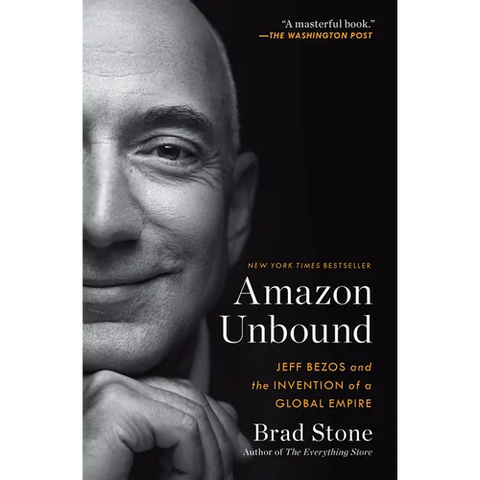
Books about the book business
If you want to go deeper, these are the ones worth your time.
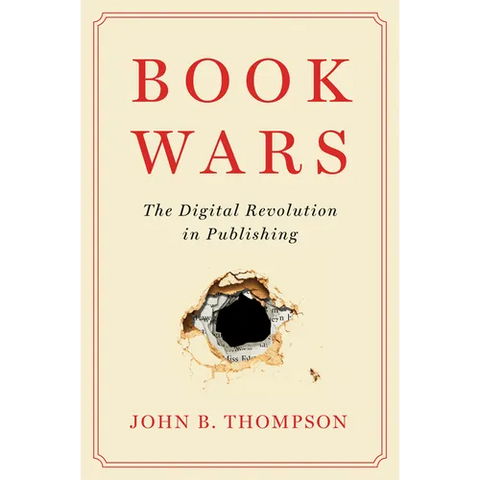
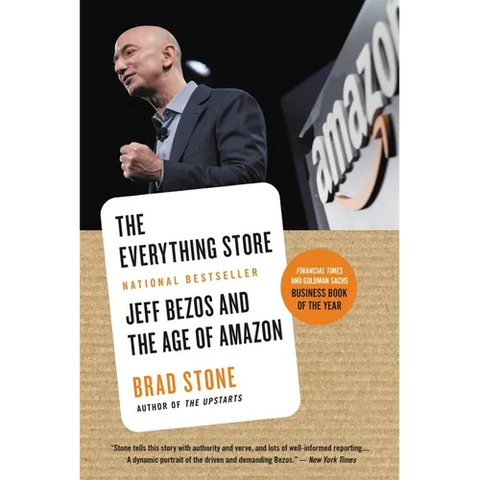
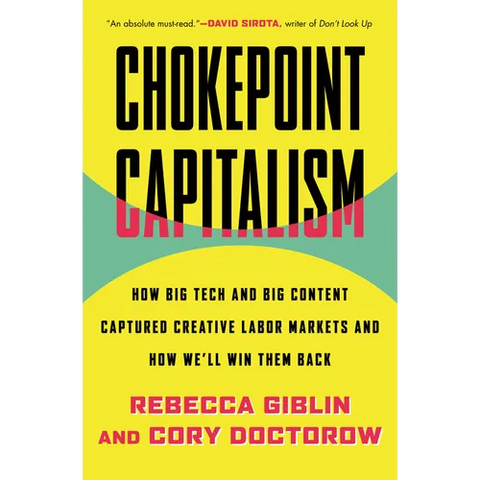
Books about consolidation and market power
And if the pattern here interests you more than the industry does, this is the broader argument.
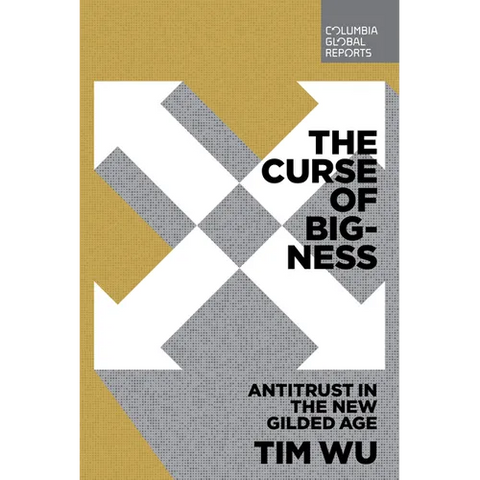
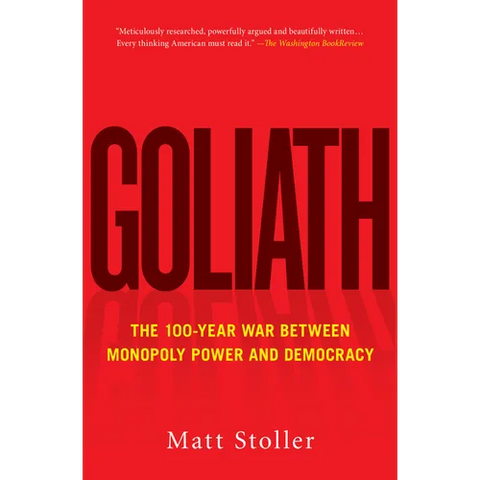
What you can actually do about it
No sermon. Just the honest options:
Libraries are the most underrated institution in this entire system. They buy books at full price, lend them indefinitely, and answer to the public rather than to shareholders.
Used books keep existing books in circulation and cost the supply chain nothing.
Small presses — Graywolf, Coffee House, Tin House, New Directions, Europa, and dozens more — publish a substantial share of the interesting books each year precisely because they don't need a title to sell 50,000 copies to justify itself.
Buying direct from authors, at events or through their own sites, sends them a far larger share than any other channel.
And independent shops, ours or anyone's. We're not going to pretend that's a disinterested recommendation — we obviously have a stake. But the reason indie shops matter isn't sentimental. It's that every additional buyer in a market is one more person deciding what's worth putting in front of readers, and the entire argument above is that the number of those people has been shrinking for forty years.
Read what you want, from wherever you want. Just know how the pipe is shaped.
Related reading
For the visible version of this argument, see our piece on what a book ban actually is and who decides. For the political machinery underneath both, 21 books that explain fascism covers how concentrated power tends to behave once it's concentrated.


